Showing posts with label consortia. Show all posts

2014-02-17

Can't we all just adapt?

Our extended hiatus from updating this blog should not be misconstrued as a resignation to the inevitability of Common Core, but may be attributed rather to the unwelcome escapades of Helicobacter pylori, for which amoxicillin and clarithromycin, both made available in the 1970’s, are part of the currently recommended recourse.  Although H. pylori are not (yet) one of the antibiotic resistant pathogens, Garry Trudeau, as drawn in a Doonesbury strip, aptly captured the contradiction of creationists’ belief that bacteria, too, exist in exactly the same form as when they were created, six millennia or so ago, by suggesting that believers not be allowed to utilize any antibiotic except for penicillin in its originally discovered form, which was indeed a potent slayer of infection 60+ years ago.
Photo source: http://microbewiki.kenyon.edu/index.php/Helicobacter

2013-11-11

PARCC re ducks

Many textbooks and other materials are lightly edited and rebranded by their creators as Common Core aligned, but being there is no central ministry of education, as in Singapore, which reviews materials and issues an official government seal of approval, anyone can make such claims with impunity.  Some education departments are making their own determinations, such as NYC, which chose “Houghton Mifflin Harcourt's ‘Go Math’ program for elementary students, and Pearson's ‘Connected Math Program 3’ for the middle grades”, or Louisiana, which last year rejected “every math and reading textbook submitted by publishers”.

The precise wording of the 93-page Common Core State Standards for Mathematics notwithstanding, a lack of consistency in interim assessments, independently developed and posed to students in states such as Kentucky, New York, Illinois and North Carolina, raises the issue of whether these test questions accurately reflect the Standards and manifest Common Core’s intent, but no matter: states, too, are barreling ahead with no independent oversight.

Carol Burris, a principal at a high school on New York’s Long Island, whose essays are often published in the Washington Post blog The Answer Sheet, recently critiqued a math test for first graders and critiqued several sample math questions.  Lest we ourselves become completely overwhelmed by myriad Common Core offerings that run the gamut, we declined to pass specific comment on those independently written questions, and instead continue to focus on states’ sample and/or actual assessments and, to date, sample-only questions designed by the two  “official” consortia, SBAC and PARCC.

This preamble brings us to PARCC’s latest batch of sample items, twelve in total, released in early November, for Grades 3-6 (nothing new for Grades 7 or 8) and high school.  Fasten your seat belt…

2013-08-19

A stroll through the PARCC

While Smarter Balanced Assessment Consortium has already administered a pilot exam with more than one million participating students, the other state consortium, Partnership for Assessment of Readiness for College and Careers, seems well behind in what is becoming a consortia war, and has already had at least one state jump ship.

To further add to our sense that PARCC is in disarray, information releases coming out of PARCC are few and far between and have this year decreased in frequency.  Nevertheless, with little fanfare, PARCC on August 19 released for public review a new series of item prototypes.  Two companies, ETS and Pearson, have contracted with PARCC “to develop the items and tasks for the PARCC mid-year, performance-based and end-of-year assessments”, but PARCC does not make clear the source of its latest batch of questions.

2013-06-26

SBAC practice tests run-through – Part 1

At the end of May 2013, following its first pilot test for students, Smarter Balanced Assessment Consortium followed up on its previous releases of sample Common Core assessment questions with new batches for grades 3 through 8 and grade 11, in the form of online practice exams.

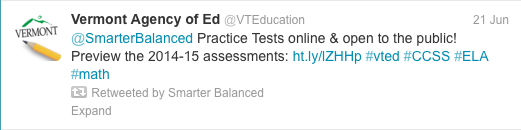
SBAC has since tweeted (read: crowed) unceasingly about these practice exams...
...and retweeted as well anyone else who’s mentioned the exams...
...in a positive light.

2013-03-29

Godzilla vs. Consortia

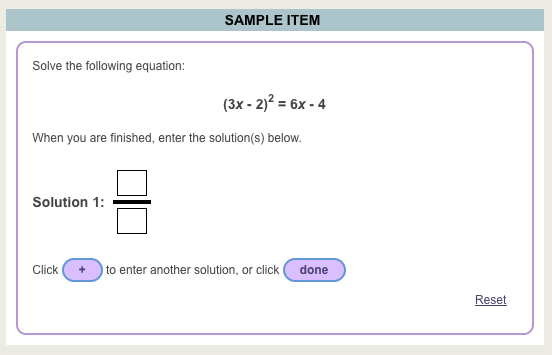
We previously examined in detail the content of a sample question coming out of Smarter Balanced Assessment Consortium, and it would be only fair to have a look at one of PARCC’s high school questions as well.  At the high school level, PARCC to date has played it safe by only releasing three official questions, all of Type I, its most basic level, which in the following example requires students to perform a mathematical procedure and enter numbers into empty boxes:
To work out this math problem, students must still resort to rewriting the entire equation on a piece of paper, with the very real possibility of a transcription error, so exactly what advantage for students has been gained by moving such assessments onto a computer?

2013-02-12

Fractions are numbers, too – Part 1

We hold these truths to be self-evident, that all numbers are created equal...
(Well, Abraham Lincoln or Thomas Jefferson could have written this.) 
On February 8&9, 2013, while much of the northeastern US was getting socked with a blizzard, a symposium was held at Educational Testing Service headquarters in Princeton.  The meeting between ETS and the National Urban League was entitled "Taking Action: Navigating the Common Core State Standards and Assessments," and the purpose was to ``discuss [the] impact of Common Core State Standards on underserved communities’’ and ``consider strategies to succeed with the new standards and assessments.’’

We stumbled across the live-twitter feed by accident, but immediately recognized the meeting's significance, as David Coleman, Joe Willhoft, and Doug Sovde, three Common Core ``biggies’’ were all featured speakers.  For them, it offered an opportunity to ``sell’’ CCSSI to important community groups: in addition to the NUL, representatives of the NAACP, NCLR and SEARAC were also in attendance.

2013-01-24

Consorting with consortia

Common Core sets the standards, and two consortia, PARCC and SBAC, will write and grade the tests that assess whether those standards were attained.  It’s a very cosy, profitable arrangement where the heaviest burdens and risks fall on the educators and students.

UCLA’s National Center for Research on Evaluation, Standards, and Student Testing (CRESST) has published this month a report called On the Road to Assessing Deeper Learning: The Status of Smarter Balanced and PARCC Assessment Consortia.

The report gives a general stamp of imprimatur to ongoing progress (what did you honestly expect?) cloaked in the usual hedged language:
Study results indicate that PARCC and Smarter Balanced summative assessments are likely to represent important goals for deeper learning, particularly those related to mastering and being able to apply core academic content and cognitive strategies related to complex thinking, communication, and problem solving.
Any challenges in implementation, the report foresees, will not be substantive but rather ``technical, fiscal, and political’’.

The CRESST report sounds one note of caution: ``Absent strong representation in the new assessments, students' deeper learning likely will be compromised.’’  Therein lies the rub: will the ``assessments call for deeper learning and reflect 21st century competencies’’?  (CRESST report, p.5)

As we at ccssimath.blogspot.com are also interested in the assessments being developed by PARCC and SBAC, we thought we’d follow CRESST’s lead and release our own status report.