The Chicago Tribune on Halloween 2013 reported “Illinois grade school test scores plunge — especially in poor communities”. Following on the heels of New York’s testing debacle, in which performance gaps widened as well, we’re beginning to detect a pattern.
The Illinois State Board of Education, on its student assessment page, reports that it had to “adjust the performance levels on the ISAT for Reading and Mathematics to better align with the more rigorous standards of the Common Core”, and a separate document entitled “2013 ISAT Mathematics Assessment”, dated December 5, 2012, and authored by “Rachel Jachino, ISBE Mathematics Principal Consultant”, states that “[a]pproximately twenty percent (20%) of the operational items on the Reading and Mathematics ISATs were written to Common Core Standards and will be included as part of students’ scores/results for the 2013 ISAT,” but it remains unclear what portion of the drop in 2013 scores is attributed to when the “state increased the scores required to pass ISAT math and reading tests by 13 to 30 points, depending on the test and grade” (Tribune), or to an actual change of test content.
Is any improvement in store for this year? Cut scores are not set by teachers, but we’re well into the 2013-2014 school year, and the 2014 ISAT Mathematics “Roadmap” (pdf), intended to guide teachers in their instruction, has yet to be released.
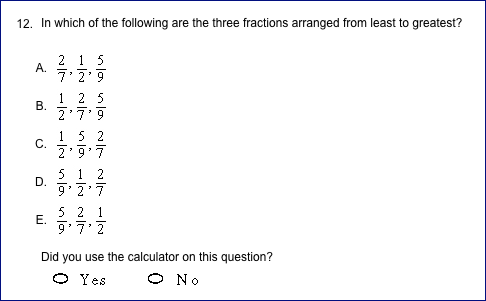
The ISBE recently removed sample questions for the 2013 tests on the premise that the “sample items displayed were not necessarily representative of the material that will appear on the 2014 ISAT”, which, incidentally, will be a one-year deal, because Illinois will “replace the ISAT with the Partnership for Assessment of Readiness for College and Careers (PARCC) assessments during the 2014-2015 school year.”
It’s a foggy road ahead indeed for Illinois teachers and their students.
The ISBE recently removed sample questions for the 2013 tests on the premise that the “sample items displayed were not necessarily representative of the material that will appear on the 2014 ISAT”, which, incidentally, will be a one-year deal, because Illinois will “replace the ISAT with the Partnership for Assessment of Readiness for College and Careers (PARCC) assessments during the 2014-2015 school year.”
It’s a foggy road ahead indeed for Illinois teachers and their students.